Friday, 7 September 2018

#52 Ancestors in 52 Weeks. Week 37, Prompt: 'Closest to your Birthday'

Week 37: 'Closest to your Birthday'

It is quite common and an interesting coincidence that many of my family members have the same birthdates or match with deaths or marriages.   I have one born on the same day as me - my great Uncle Charles Albert Pearce, however, I wrote about him in Week 35 for the 'Back to School' prompt.  Other than him I only have very distant ones such as - a great Uncle of a 6th great uncle, and a father-in-law of a 1st cousin twice removed and unfortunately, they died on my birthday. 

So, I decided I would try my husband’s birthday and there I found something a little happier - a marriage on his birthday. Thus, they are the lucky ones selected for this story.


Meet - Charlotte Elizabeth Palmer my great, great Aunt

and her new husband Lewis Hopkins who married on 25 January 1876 in Chorlton Upon Medlock, Lancashire, England (sadly no photo of Lewis).

Charlotte was 28 years of age and Lewis was older at forty.

I am lucky to have a nice picture of Charlotte, although she looks a little severe. Mind you I think I would in those days too with trusses and heaven knows what on.  And don’t they say that the photographer asked you to sit very still for quite a while whilst he did all the things you had to do then to take a photograph.


Now of course working in genealogy can bring about some funny, strange and serendipitous things.  When I researched Charlotte’s vital stats, lo and behold I found her baptism was  - 27 July 1847 - the day after my birthday!  Ha Ha, I do have a closer direct line person born near my birthday after all.   


Charlotte was the sixth child of Esau PALMER and Mary Ann WALL born in their home at Broad Street Ross on Wye in Herefordshire, England. She had eight siblings, namely: Mary Sophia, James Esau George, Edward, Edith Annie, Arthur Samuel (my great grandfather), John Henry Wall, Gertrude Edith, and Herbert William. 

I have these old-fashioned little photocopies - little thumbnails that will go fuzzier if I enlarge them. I have been given the page by other family members, probably copies of copies of copies – but I am happy to have them and put them on display.  


   Mary Sophia,     James Esau,        Edward      -       Top row
    Edith                    Arthur S,         Charlotte     -       Centre
    John H W             Gertrude            Herbert     -       Bottom


Source: from Joyce HARDIE who has put them in age order.


***
                
It seems that Charlotte lived at home until she married and then she and Lewis resided at 175 Castle Road Cardiff.  Later, 02 Apr 1911 the family are living at 189 City Road Cardiff.
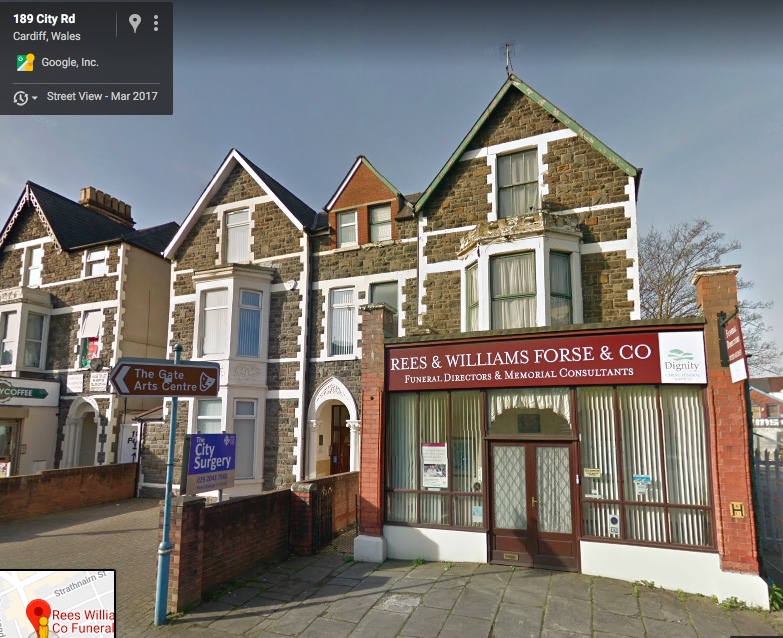


189 City Road Cardiff in 2018


Charlotte died 29 Dec 1921 at home in 17 Howard Gardens, Cardiff, Wales (Information from Kath Gillespie, from D Morgan).


This Row of houses is ‘Howard Gardens’ in Cardiff in 2018. 
Lewis and Charlotte’s home would have been one of these.
(A very similar style to the City Road row above)


Charlotte and Lewis HOPKINS had the following seven children, all born in Cardiff, Glamorgan, Wales. 
(From Kenneth Palmer Humpidge via Kath Gillespie)

1.    Lewis Ernest - Oct 1877.
2.  John Blount  - Oct 1878. He died 14 Jan 1923 in Cardiff.
3.  Edith Frances – unknown year
4.Miriam Olive - about 1881. 
5.  Florence Palmer - 09 Jun 1882.  Married Roland James SULLY on 28 Jul 1909 in Plasnewydd, Chap, Cardiff, Montgomeryshire, Wales.  Died on 22 Dec 1984 in Evergreens, Abbots Leigh, Avon, 
6.  Mary Elizabeth - about 1884 (Molly).
7.   Bertram Lewis - 1888. He died on 17 Mar 1962 in Cardiff.


The 1881 Wales Census tells me that they had a nurse living in to help with the four babies aged from 0 to 3. They also had a domestic tenant. Sounds like it was a pretty big home and there was a little money in the family.


Charlotte was buried on 01 Jan 1922 in Cathays Cemetery, Plot V255, Cardiff, Wales. 
(From Kath G. from Diane Morgan in Wales who is also a descendant of Charlotte E Palmer. Also listed in 'Find A Grave' but unfortunately no picture.)


***

Lewis Hopkins was born to John Blount HOPKINS and Martha EDY, 10 May 1835 in Angel St, Cardiff, Wales. He was the first child and had six siblings, namely: Elizabeth, George, Samuel P,  Sarah Amelia, Francis R, and Miriam Martha. 


 Birth Register for Lewis Hopkins 10 May 1835

As a young lad of 15 years, Lewis worked in his father’s grocery shop while all his younger siblings were scholars. 
Dad – John Blount Hopkins, was a chandler and grocer according to the 1851 Wales Census. 

In the 1871 Wales Census, Lewis has become an Iron Dealer’s clerk.  He was 35, head of the house ‘Dunster House’ in St John, Glamorgan sharing with 3 of his sisters (single) plus a one-year-old nephew John Norman Sully and a girl servant. Sarah Amelia was 28, Elizabeth 24, and both are school teachers with Miriam Martha 23, being a Music Teacher.

The next we know Lewis is a Real Estate Agent and Auctioneer as well as a Registrar of Marriages in 1881. 

He died 1 year after Charlotte on 29 Dec 1922 at home in 17 Howard Gardens, Cardiff, Wales.  He was buried on 01 Jan 1922 in Cathays Cemetery with Charlotte in the same plot.  One son John Blount who died in 1923 is also buried with his parents.


Lewis Hopkins signature 1911


***


And what was happening in Wales in the years of Charlotte and Lewis’ lives?

Well, for a start when Charlotte was born the large railways were opening up – 'The North Wales' and 'The Great Western' Railways, transport was easier.   

Coal mining was rapidly developing. 

The secret ballot was introduced in 1872. 

Foreign competition caused agricultural depression in 1878 
and seven years later brought the first Tithe riots. 

When Charlotte was 50 years old, Marconi transmitted the first ever wireless communication across the open sea. From Lavernock, just outside Cardiff, to Flatholm Island.

Mining disputes were breaking out and with other troubles would lead up to the General Strike of 1926. 

In 1914 an important person was born - Dylan Thomas.
1914-1918 World War One.
In 1918, in Wales, women were awarded limited female suffrage. 

Now through all of this,  Wales continued to lead in rugby league winning many home nation competitions 

I wonder how much of this had any impact on Charlotte and Lewis and the family?


Thursday, 6 September 2018

#52 Ancestors in 52 Weeks. Week 36, Prompt: ‘Work'

Week 36:  'Work'

I was thinking about the ’work’ prompt and started to reminisce about my father and his hard work on the orchard.  Then back to his father who came out from Scotland to become an orchardist in Victoria.  That led me to wonder how long orchards had been established in the Goulburn Valley where we lived.

Regarding the ‘white’ habitation of Victoria - in 1800 the ‘Lady Nelson’ was first to sail through Bass Strait from West to East, and in 1802 she brought the first Europeans to Port Phillip, ten weeks before Flinders arrived in the Investigator in April 1802. 
Another year passed and in January and February 1803 Grimes, for Governor King of NSW, also surveyed Port Phillip and discovered the Yarra River but discouraged settlement.  It was over 30 years before Melbourne was established when the explorers helped with opening up the land and influence the further settlement of the Port Phillip region.
In 1835-6, Surveyor-General of NSW, Major Thomas Mitchell crossed the Murray River and proceeded south to Portland then northeast finding fertile land which impressed him so much that he termed the region ‘Australia Felix’, thus inspiring subsequent settlement.

Aboriginal groups inhabited Victoria including the Goulburn Valley region prior to European settlement. There was an existing culture and peoples specific to this area, fully formed and complex.  (It is still living and vibrant today.)  Downstream at Shepparton, the area was inhabited by the Yorta Yorta people.
“The Aboriginal peoples lived harmoniously according to the natural cycles of the land and rhythms, and moved through country on a seasonal basis, occupying the cooler more mountainous areas in summer and autumn, and the tributaries of the Goulburn in winter and spring.
Food was plentiful around the region’s waterways with emus, kangaroos, possums, wombats, freshwater fish and abundant plant foods harvested by the clans”.

I haven’t been able to find how these first inhabitants were treated by the European settlers.  But I know there was an Aboriginal Protectorate Station from 1840 - 1853 at Murchison  34.5 km (21.4miles)North of Shepparton on the Goulburn River.  It was the focus of interaction between Aboriginal communities, including the Yorta Yorta peoples, government officials, and settlers during the early years of contact in the Port Phillip District. The site continued to hold significance to Aboriginal people after the 1850s, linking pre- and post-contact histories and geographies.

In 1836 Major Mitchell crossed the Goulburn at Mitchellstown near Nagambie and soon afterward overlanders and other early settlers began to use this crossing place on the Melbourne-Sydney route (now known as the Hume Highway).   

Commercial fruit growing in Australia began with the First Fleet and can be said to be based largely on introduced species.  On the voyage to Australia, Governor Arthur Phillip obtained seeds and plants of fruit trees en route from Rio de Janeiro and the Cape of Good Hope, which were planted at Farm Cove in Sydney, in 1788. Early settlers created a growing demand for fruit, vines and other plants for their estates, and many cultivated their own orchards and vineyards.2


The Goulburn Valley has some of the most fertile soils in Australia and is a major fruit-growing area. The Shepparton Fine Sandy Loams which dominate the fruit growing areas are highly suited to irrigated annual and perennial horticultural crops.  The Mediterranean climate suits the production of a wide variety of fruits and vegetables throughout the season and is renowned as the food bowl of Australia.

This sub-region of the Hume consists of those areas in the catchment of the Goulburn River and other nearby streams and is part of the Murray-Darling Basin. Water for irrigation is sourced from Lake Eildon and Goulburn Weir, with Lake Eildon supplying over half the water used in the Shepparton irrigation district.  The fruit grown,  supplies the processing plants in Shepparton and nearby. The SPC Ardmona plant, founded as SPC in Shepparton is one of the world's largest fruit canneries.

The industry, which is labour intensive and seasonal, comprises small-scale family farms, but with a fast growing trend towards larger scale operations. Production involves the growing of fruit and vegetables for domestic and export markets, as well as large-scale processing and canning operations. With its soils, irrigation water and connectivity to capital cities and export markets, the Goulburn Valley has prospered.  The industry has a long-held reputation for quality, primarily due to the high standards across all stages of the supply chain, from farmer to consumer.

The first fruit growers association was formed in the Goulburn Valley in 1891.  
Before the 19th century industrialization, 'paddock to plate' distribution usually involved face-to-face contact between growers and consumers. Local farmers brought their excess produce into town for direct sale at the market. Time taken getting produce to market took its toll on quality and productivity as carting goods by road took farmers from their fields. 
Transportation by river, rail, and motorized vehicles saw increased productivity while canning, drying and refrigeration allowed for long distance freighting without waste. 
Since the mid 20th century, most products on our grocery store shelves have usually travelled countless miles and been handled by many people by the time they are ready for purchase. The increasing number of processes between the farm gate and our plates has seen primary producers and consumers pushed ever further apart.

Up until the 1980s, the industry was cushioned by protectionist policies; but in later years, Goulburn Valley growers have unfortunately been put under increased pressure by international markets and retailers.

________________________________________________________________________________

So back to how my family joined the hard working orchard community.  I am including below memories from my Aunt Tib, my father’s sister, that she wrote in her later years.

“In August 1912  settlers were needed to take over the irrigation blocks then being opened up  in the Goulburn Valley.  With eight sons in our Pearce family, there was not enough work for them all in the family business: Wm Pearce & Sons. Soft Drink Factory.
Four of the boys decided to emigrate, three to Canada and one to Australia. 
George Francis Pearce [‘Geordie’, My Grandfather] thought there would be good prospects in Australia for his family. He and his wife Isabella and their five children sailed on the Demosthenes on 25 June 1912“. 

'Demosthenes'


Notice in paper 10 August 1912 re: the arrival of 'Demosthenes'

“Our family had a short stay in Melbourne while Dad [Geordie] came down to Shepparton to choose a block of land a few miles east of the town in what was called No 2 Settlement and later became known as Orrvale and Shepparton East.  Irrigation channels were new and mostly had just some muddy water lying in the bottom.  Blocks were marked out with surveyors pegs. The land had been used to grow wheat and there were old farmhouses here and there, but our block had no home on it and we lived in a tent for 6 weeks all through a rainy September, while our two-roomed house was being built. It was the standard type of weatherboard dwelling provided for the settlers  - 2 large rooms and a verandah, roofed with corrugated iron and lined with tongue and groove boards. There was a corrugated iron tank for water on a strong stand at the back door.
Dad built all the fences and then planted the young trees with help from us.

[There was a lot of work to maintain the trees and keep them watered, working the irrigation system day and night depending on the weather.]

By 1916 fruit trees were coming into bearing and markets had to be found.  A Fruit Grower’s Association had been formed and we had all learned that orcharding was to provide our livelihood, and we would all be involved.  Dad had been employed by the State Rivers and Water Supply Commission as a channel guard for the statutory wage of eight shillings per day, 5 1/2 days per week.

In late 1917, a meeting was held in the Orrvale church with a parliamentary representative, some Shepparton businessmen, and leaders of the fruit growers. The meeting determined to build a cannery - Shepparton Preserving Company.  The cannery opened in early 1919, ready to process the peach harvest.  This was all overshadowed from the background by World War One and the restrictions that that imposed."

Geordie Pearce

"Sadly, Dad died 30 June 1922 of pneumonia.  William [my dad] as the oldest son managed the orchard with his mother and the 2 younger boys helping. They took over the orchard block and house next door when the earlier owner left it. This made a fair size and worthwhile orchard of 45 acres.


Summertime in the old days on the orchard - I think of the routine - sorting and packing fruit, stamping boxes, cutting ripe apricots and spreading them out on trays to dry in the sun.  Oh my, how good it was to come to ‘knock off’ time at the long day’s end”.6


The first farm tractor

Boxes for packing fruit for the Melbourne market


Hand sorting and grading
James, Sarah (Ray), William and George Pearce


William spraying the trees


Sultanas drying on racks